
Disclosure: As an Amazon Associate, Kyaraban earns from qualifying purchases. This article contains affiliate links.
There is a quiet friction to the morning that electric appliances have spent decades trying to erase.
You press a button on a motorized grinder, and a mechanical shriek fills the kitchen while a plastic chamber fogs with static-charged chaff. In seconds, the job is done. The beans are pulverized, the water is heating, and the ritual has been reduced to a means to an end.
Switch to a manual hand grinder, and the entire calculus of the morning shifts.
Instead of an aggressive roar, there is only the rhythmic mechanical crunch of beans passing through hardened steel, transmitted through the crank and the weight of the grinder into your hand. You feel the resistance change as the beans yield, hear the subtle movement of the bearings, and by the time you finish, you have physically participated in the brewing process before a single drop of water reaches the coffee bed.
The manual grinder is one of those rare everyday objects that rewards attention with a tangibly different result. But the appeal is not merely aesthetic. Particle size and consistency have a major influence on how evenly coffee extracts and, ultimately, how the cup tastes.
Our four picks for this setup
KINGrinder K6 — versatile everyday workhorse →
TIMEMORE Chestnut C5 Pro — compact all-metal option →
The Physics of the Burr: Slices vs. Crushes
To understand why a good hand grinder can change your morning cup, you have to look past the casing and into the milling chamber.
Inexpensive blade grinders rely on a fast-spinning blade that repeatedly strikes the beans. The resulting mixture can contain both very small particles and much larger fragments, making even extraction harder to control.
Many modern specialty hand grinders instead use precision-machined stainless-steel conical burrs. Beans are drawn between two patterned surfaces and reduced progressively to the selected grind size.
- Controlled particle formation: Burr geometry draws the bean downward and breaks it progressively rather than simply battering it around a chamber.
- Better consistency: A more uniform grind makes it easier to control extraction and can produce a cleaner, more articulate cup.
When you turn the crank, you are not merely crushing beans. You are controlling one of the most consequential variables in the brewing process.
Micro-Adjustments: Dialing In the Grind
One of the old complaints about manual grinders was guesswork. Many earlier designs required adjustment underneath the burr or inside the grinder, which made changing settings awkward.
Modern premium hand grinders increasingly use visible external adjustment systems, allowing small, repeatable changes without dismantling the grinder.
- Stepped precision: Fine click adjustments make it easier to return to a known setting or move methodically between brewing methods.
- Stability: Bearing-supported central shafts help keep the burr assembly aligned under load, contributing to more consistent grinding.
The KINGrinder K6, for example, uses an external adjustment system with 60 clicks per rotation and 16-micron movement per click. Its aluminum body and stainless-steel burr set make it a particularly compelling entry into this more engineered class of hand grinder.
The Ritual and Material Culture
There is an intentionality to manual grinding that changes your relationship with the tool.
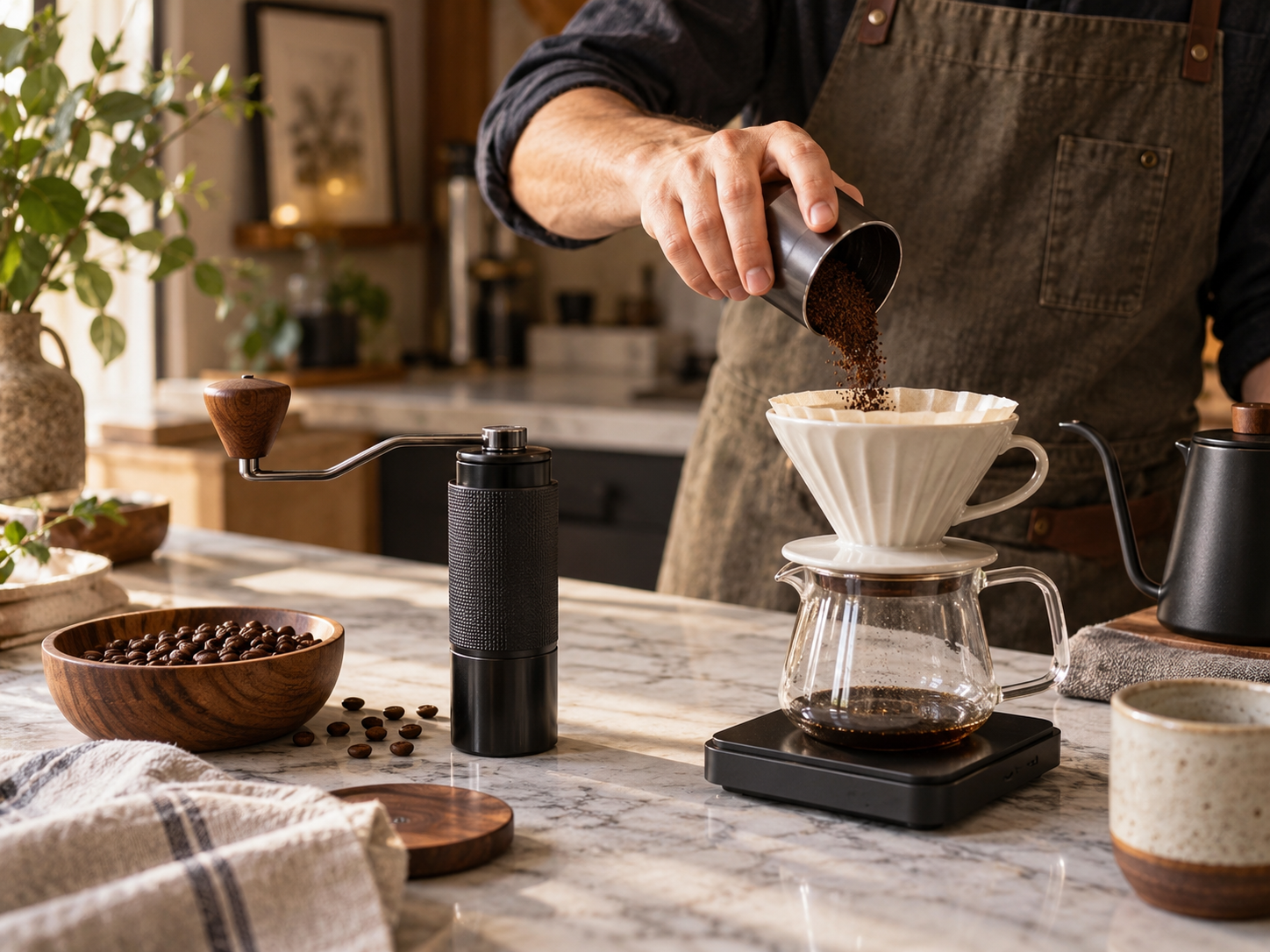
Weighing out a dose of beans, smelling the dry aromatics as they enter the hopper, and feeling the gradual release of resistance as the burrs finish their work creates a tactile connection to the process. Better grinders are built from materials such as aluminum and stainless steel, with components intended for repeated use rather than disposable convenience.
A typical dose can often be ground in well under a minute, depending on the grinder, roast, grind setting, and amount of coffee. Far from being a chore, that brief interval can become a natural anchor for the morning—a small pause before the rest of the day begins.
This is the same reason objects such as a well-made Japanese gyuto knife belong naturally in Kyaraban: the appeal lies not only in performance, but in the physical experience of using an object designed with care.

Choosing Your Manual Grinder: Three Tiers of Craft
Depending on your brewing habits, counter space, travel needs, and appetite for precision, three very different grinders make sense.
1. For Everyday Precision: KINGrinder K6
The KINGrinder K6 Manual Coffee Grinder is the all-rounder of the group.
It uses a large stainless-steel burr set, a full aluminum body, and an external adjustment mechanism that moves in 16-micron increments. KINGrinder positions the K6 as a versatile grinder capable of handling several brewing methods, which makes it an appealing choice for someone who wants one serious grinder without moving immediately into enthusiast pricing.
It also has enough adjustment range to move from finer grinds toward coarser brewing methods without requiring the user to open the grinder and alter an internal dial.
See the KINGrinder K6 on Amazon →
2. For Compact Design and Travel: TIMEMORE Chestnut C5 Pro
The TIMEMORE Chestnut C5 Pro takes a more compact, design-forward approach.
Its all-metal body houses TIMEMORE’s 42 mm S2C-042-III seven-blade burr. The C5 Pro offers 48 total adjustment clicks, with adjustment increments of 0.031 mm per click, along with a pull-to-fold handle and a 25 g catch cup.
That combination makes it particularly attractive for a smaller kitchen or a travel kit: substantial enough to feel like a serious piece of equipment, yet compact enough to pack alongside a brewer.
See the TIMEMORE Chestnut C5 Pro on Amazon →
3. For the Enthusiast: 1Zpresso J-Ultra
The 1Zpresso J-Ultra occupies a different territory. This is the most specialized and premium grinder in the group, and it is particularly aimed at espresso drinkers.
Its coated 48 mm burr set is paired with an extraordinarily fine external adjustment system: 100 clicks per rotation and just 8 microns of burr movement per click. A magnetic catch cup, foldable handle, and 35–40 g capacity reinforce the sense that this is not simply a basic hand mill but a precision instrument.
If your morning coffee involves espresso and you enjoy dialing in small changes from shot to shot, the J-Ultra’s unusually fine adjustment range is precisely the sort of mechanical detail that justifies moving into the premium tier.
See the 1Zpresso J-Ultra on Amazon →
The Companion Object: The CHEMEX Classic
Once the beans have been reduced to a controlled bed of grounds, the next object in the ritual is the brewer itself.
For this article, we chose the CHEMEX Classic Pour-Over Coffeemaker rather than another piece of anonymous coffee equipment because the CHEMEX is an object with a genuine design lineage.
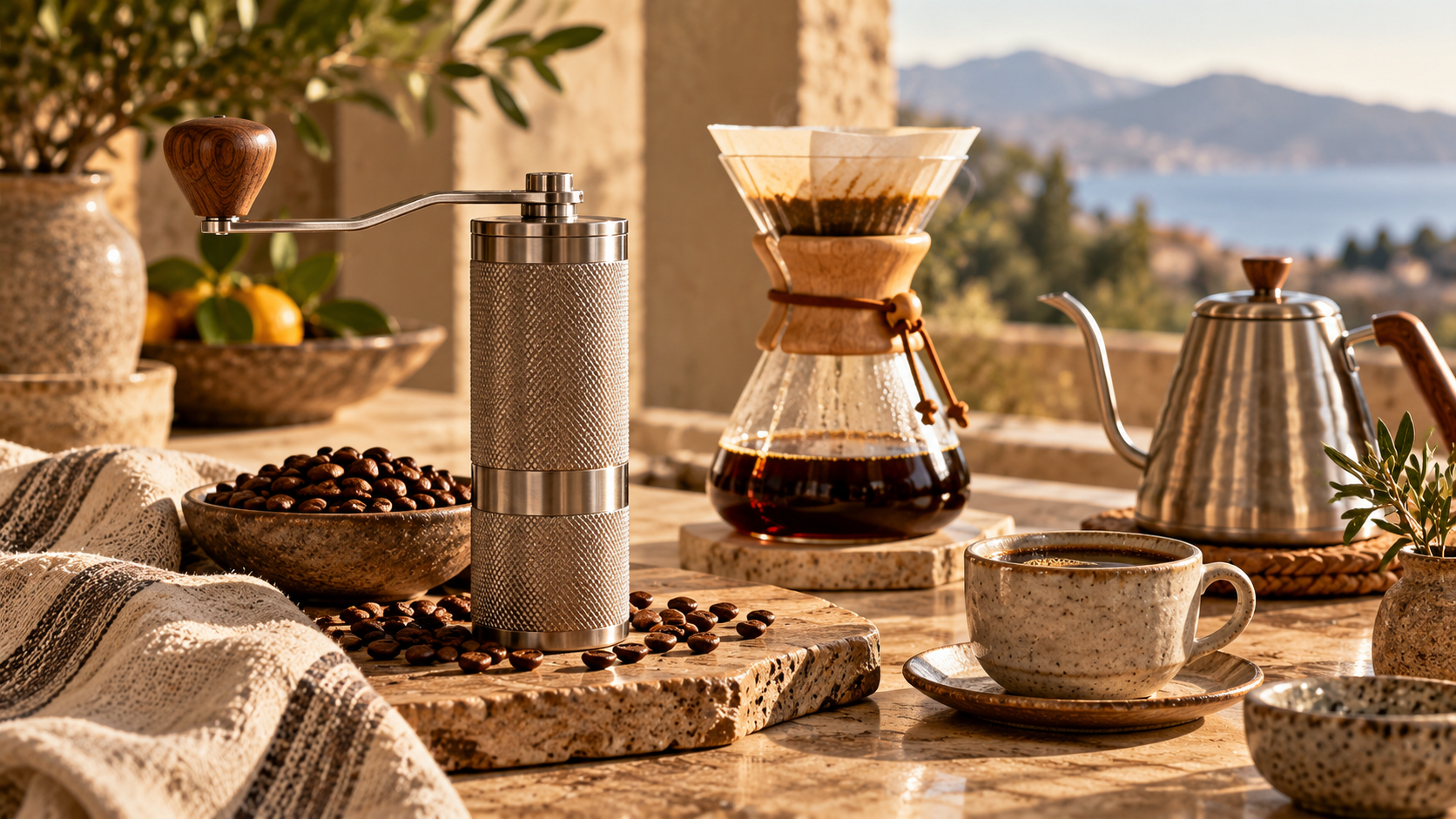
Chemist and inventor Peter Schlumbohm designed and patented the CHEMEX in 1941. Its form drew on laboratory glassware and modernist design: a single hourglass-shaped piece of borosilicate glass wrapped at the waist with a wooden collar and rawhide tie.
That visual restraint has given it an unusual life beyond the kitchen. The CHEMEX has been recognized by design institutions and is represented in museum collections, including the Museum of Modern Art in New York.
More importantly, it remains useful. The wide glass vessel, bonded paper filter system, and simple pour-over method turn coffee preparation into something visible and deliberate rather than hidden inside a machine.
See the CHEMEX Classic on Amazon →

Slower, but Better on Purpose
There is nothing efficient about turning a crank when an electric motor can do the work in seconds. That is precisely the point.
Hand grinding preserves a small piece of friction in a routine that has otherwise been engineered toward instant convenience. In exchange, you gain direct control over grind size, a quieter kitchen, a piece of equipment that can travel without electricity, and the oddly satisfying feeling of making something with your hands before you drink it.
The best manual grinders do not make coffee interesting by adding complexity. They make the mechanics visible again.
And paired with an object like the CHEMEX—glass, wood, paper, water, coffee—the entire process becomes unusually legible: beans go in, grounds come out, water passes through them, and coffee collects below.
That simplicity is part of what makes these objects worth owning.
For more design-led objects and useful tools, browse Kyaraban Finds, or explore our earlier collection of 10 Remarkable Finds From Around the World.